
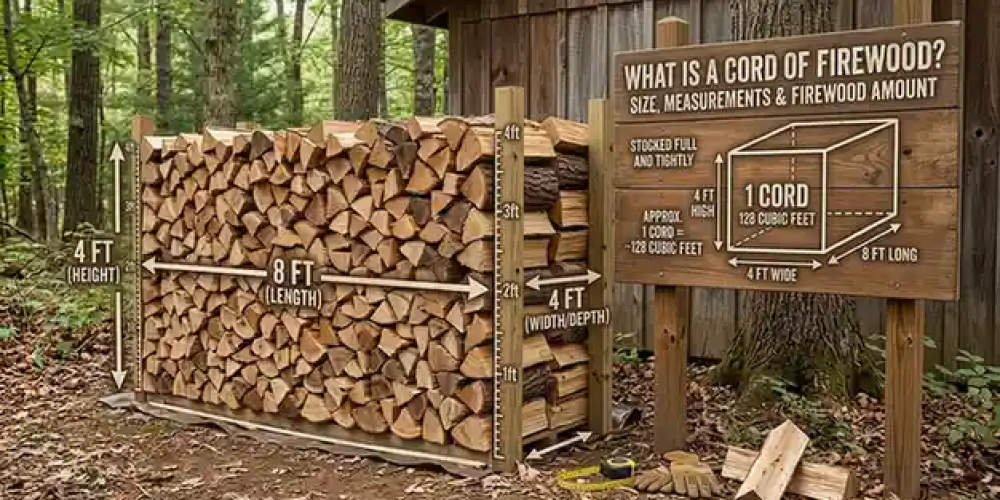
A cord of firewood is a standardized unit of measurement equal to 128 cubic feet of tightly stacked wood. A full cord stacks to exactly 4 feet high × 4 feet wide × 8 feet long — and it is the most widely recognized and legally defined firewood measurement used across the United States.
If you have ever searched “what is a firewood cord,” “how big is a cord of wood,” or “how much firewood is in a cord” before placing a firewood order, you are already ahead of most buyers. Understanding what a cord actually means — in real dimensions, real volume, and real quantity — protects you from receiving less wood than you paid for and helps you order the right amount for your specific heating needs.
At 12 Point Farms LLC, we measure every cord accurately and deliver exactly what our customers order — no shortcuts, no short cords, no guesswork. This guide explains everything you need to know about firewood cord measurements before you buy.
Quick Answer — What Is Firewood Cord?
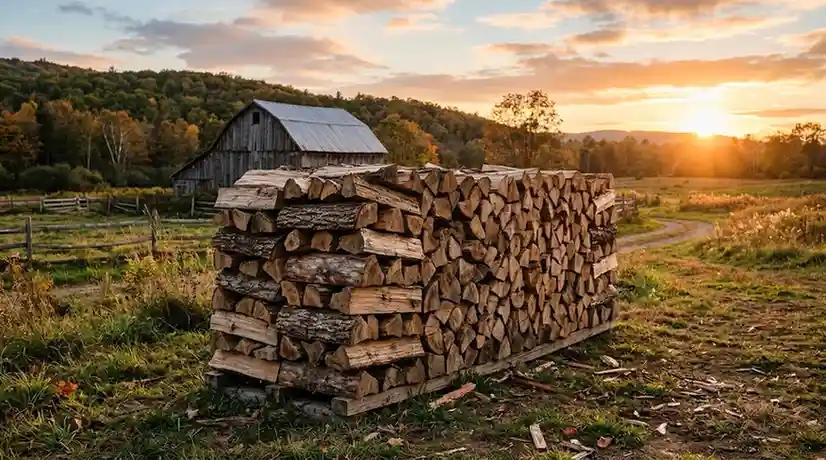
A cord of firewood = 128 cubic feet of stacked wood, measuring 4 ft high × 4 ft wide × 8 ft long. It is the standard legal firewood measurement in the United States. A full cord contains approximately 80–90 cubic feet of actual solid wood, with the remainder being air space between stacked pieces.
What Is a Cord of Firewood?
A cord of firewood is a precisely defined volume measurement — not a weight, not a truck-load estimate, and not an informal quantity. It is a standardized unit with specific dimensions that most US states recognize in consumer protection law when firewood is sold commercially.
The official definition: one cord of firewood = 128 cubic feet of wood as stacked.
This definition comes from the physical dimensions of the standard cord stack:
- Height: 4 feet
- Width: 4 feet
- Length: 8 feet
- Total volume: 4 × 4 × 8 = 128 cubic feet
The “as stacked” qualifier is critical. A cord is measured based on the total volume of the stack — including the air spaces between individual pieces of wood. The actual solid wood content inside a properly stacked full cord is approximately 80 to 90 cubic feet, with the remaining 38 to 48 cubic feet being natural air gaps between split pieces.
This is not a defect or a shortcoming — it is simply the physical reality of how split wood stacks. A tighter stack with smaller, more uniform pieces will contain more solid wood per cord. A looser stack with large, irregular pieces will contain slightly less.
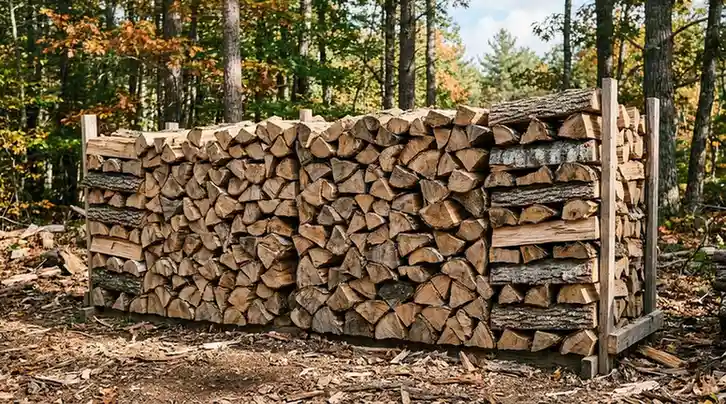
Why this measurement matters to buyers:
Firewood is commonly sold in quantities described loosely as “loads,” “ricks,” “face cords,” or “bundles” — terms that mean very different things in terms of actual wood volume. Understanding the cord as the baseline measurement gives you the ability to compare quantities accurately and verify that you are receiving fair value for every dollar spent on firewood.
How Big Is a Full Cord of Firewood?
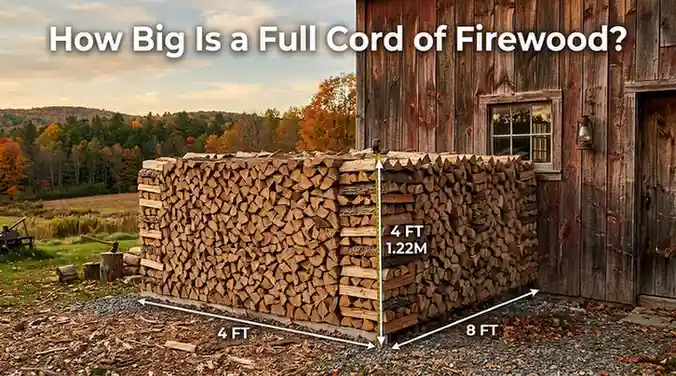
A full cord of firewood is larger than most first-time buyers expect — and visualizing it correctly before ordering helps you plan where to stack your delivery and how much storage space you actually need.
Standard Cord Dimensions
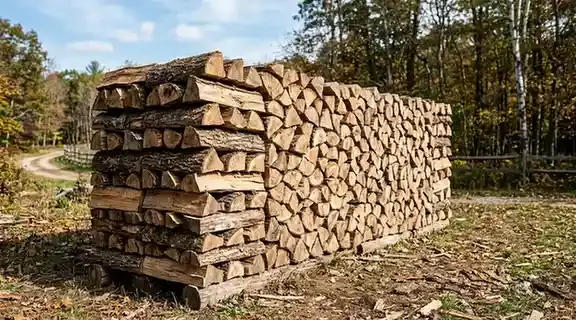
The dimensions of a standard full cord are fixed and universally consistent across the United States:
| Dimension | Measurement |
|---|---|
| Height | 4 feet |
| Width (depth) | 4 feet |
| Length | 8 feet |
| Total stacked volume | 128 cubic feet |
| Solid wood content | ~80–90 cubic feet |
| Air space | ~38–48 cubic feet |
To picture this in practical terms: a full cord of firewood stacked against a wall would create a row 8 feet long, 4 feet tall, and 4 feet deep. That is roughly the size of a standard interior doorway in both height and width, extended 8 feet along a wall.
A standard pickup truck bed holds approximately one-third to one-half of a cord depending on how tightly the wood is loaded and how long the log pieces are. A full cord typically requires a large pickup with a full 8-foot bed, loaded to capacity, or a dedicated delivery vehicle. This is why a single pickup truck load — sometimes marketed informally as “a cord” by casual sellers — almost never contains a true full cord of wood.
Cubic Volume of a Full Cord
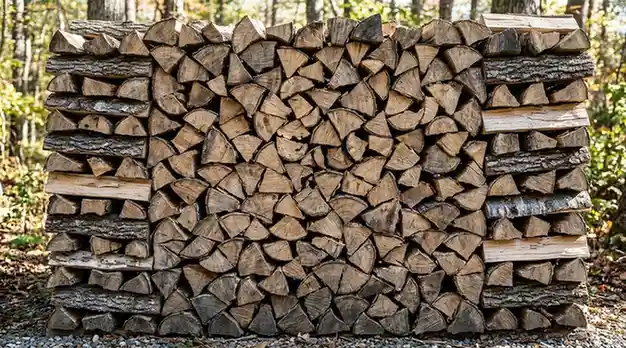
The 128 cubic feet figure is the total stacked volume — the space the stack occupies, including air. The actual solid wood volume within that space depends on how tightly and uniformly the pieces are stacked.
Typical solid wood content by stacking quality:
| Stacking Method | Approximate Solid Wood |
|---|---|
| Very tight, uniform pieces | ~90 cubic feet |
| Standard neat stacking | ~80–85 cubic feet |
| Loose or irregular stacking | ~70–75 cubic feet |
This is why stacking method matters both for accurate measurement and for storage efficiency. A loosely thrown pile of the same volume of wood will contain meaningfully less actual firewood than a neatly, tightly stacked cord — even if both occupy 128 cubic feet of space.
Why Stacking Matters
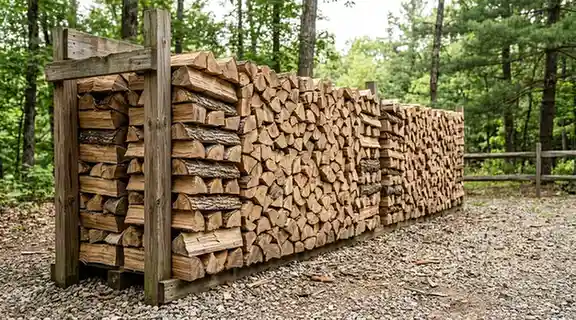
Stacking is not just about organization — it directly determines whether you receive a full cord of firewood.
When a reputable supplier delivers a cord of firewood, the wood should be stacked neatly and tightly enough that the total stacked dimensions measure 4 × 4 × 8 feet. A delivery that is loosely thrown in a pile and then measured against cord dimensions will contain significantly less actual wood than a properly stacked cord of the same nominal volume.
The correct approach when receiving a firewood delivery: stack the wood before measuring, then verify the dimensions match the cord size you ordered. Read our guide on properly stacking firewood to understand the correct technique that maximizes both measurement accuracy and long-term wood quality.
How Much Firewood Is in a Cord?
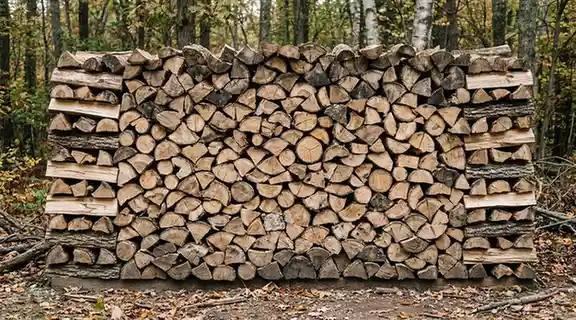
128 cubic feet of stacked firewood is the volume of a cord — but “how much firewood” in practical terms depends on what you are asking.
If the question is about volume: 128 cubic feet stacked, approximately 80 to 90 cubic feet of solid wood.
If the question is about how many individual pieces: the number varies significantly and cannot be given as a fixed number. The piece count in any cord of firewood depends entirely on how long each piece is cut, how finely the wood is split, and the natural variation in log diameter from piece to piece.
A rough practical estimate: a full cord of 16-inch split hardwood typically contains somewhere between 400 and 700 individual pieces — a range that reflects the enormous variation in splitting size and log diameter across different firewood deliveries.
The takeaway for buyers: never evaluate a firewood delivery by counting pieces. Measure the stack dimensions. Volume is the only reliable way to verify a full cord.
Full Cord vs Face Cord vs Half Cord
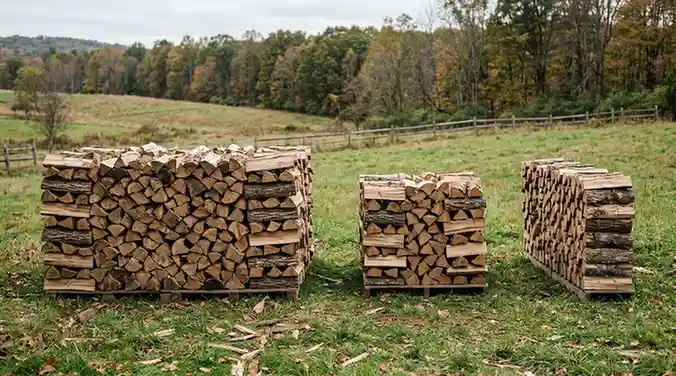
One of the most common sources of confusion — and disappointment — among firewood buyers is the difference between a full cord and the various fractional cord terms used by suppliers. Here is a clear, side-by-side breakdown:
| Cord Type | Dimensions | Volume | % of Full Cord |
|---|---|---|---|
| Full Cord | 4 ft × 4 ft × 8 ft | 128 cu ft | 100% |
| Half Cord | 4 ft × 4 ft × 4 ft | 64 cu ft | 50% |
| Face Cord | 4 ft × 8 ft × ~16 in | ~42–43 cu ft | ~33% |
| Quarter Cord | 4 ft × 4 ft × 2 ft | 32 cu ft | 25% |
| Rick | Same as face cord | ~42 cu ft | ~33% |
Full Cord
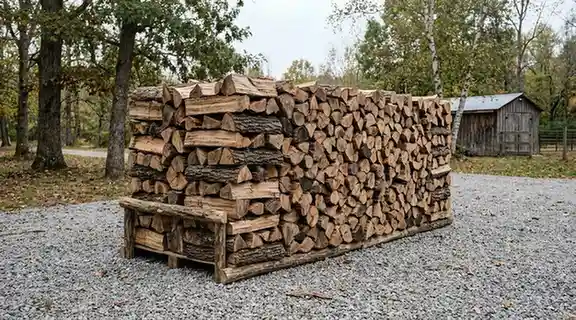
The full cord is the baseline standard — 128 cubic feet of tightly stacked wood, 4 feet × 4 feet × 8 feet. It is the most cost-effective purchase per unit of wood volume and the best choice for homeowners heating primarily with wood through an entire winter season.
A full cord of hardwood firewood is substantial — it typically weighs between 2,000 and 5,000 pounds depending on species and moisture content, and it requires a dedicated storage area of at least 8 feet long by 4 feet wide. Plan your storage space before ordering. For detailed full cord guidance, visit our full cord firewood resource.
Face Cord
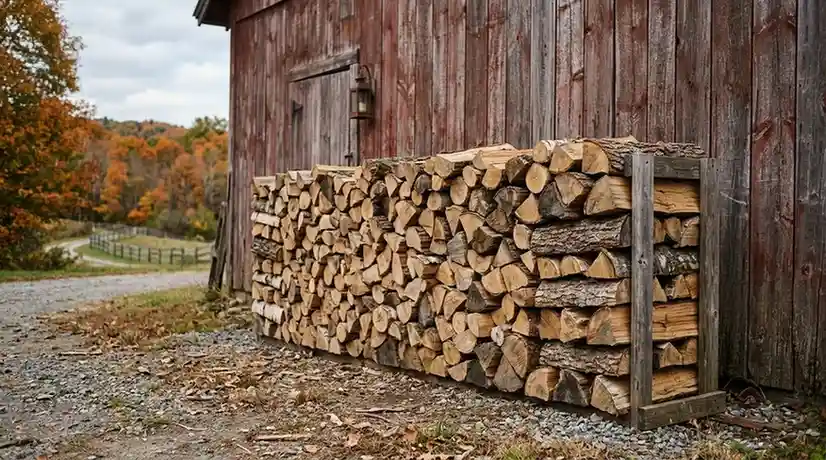
A face cord — also called a rick of wood or a single-split cord — is one of the most misunderstood firewood quantities in the industry. A face cord appears to be a full cord when viewed from the front: it measures 4 feet high and 8 feet long, identical to a full cord in those two dimensions.
The critical difference is depth. A face cord is only as deep as the length of the individual split pieces — typically 16 inches for standard fireplace wood. At 16 inches deep, a face cord measures:
4 ft × 8 ft × 1.33 ft = approximately 42.6 cubic feet
That is roughly one-third of a full cord — not one cord. A homeowner who orders a “cord” and receives a face cord has received approximately 33% of the wood volume they paid for.
Always clarify with any supplier whether they are quoting a full cord or a face cord. The price should reflect the difference significantly.
Half Cord
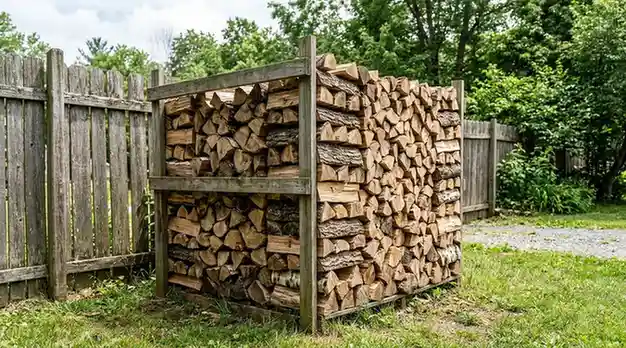
A half cord of firewood measures exactly half the volume of a full cord: 4 feet high × 4 feet wide × 4 feet long = 64 cubic feet. It is the most popular firewood quantity for homeowners who use their fireplace recreationally or need supplemental heating rather than a primary wood heat source.
A half cord is also an excellent first-order quantity for new customers who want to evaluate a supplier’s quality and measurement accuracy before committing to a full cord purchase. Visit our half cord firewood guide for sizing and storage details.
Quarter Cord
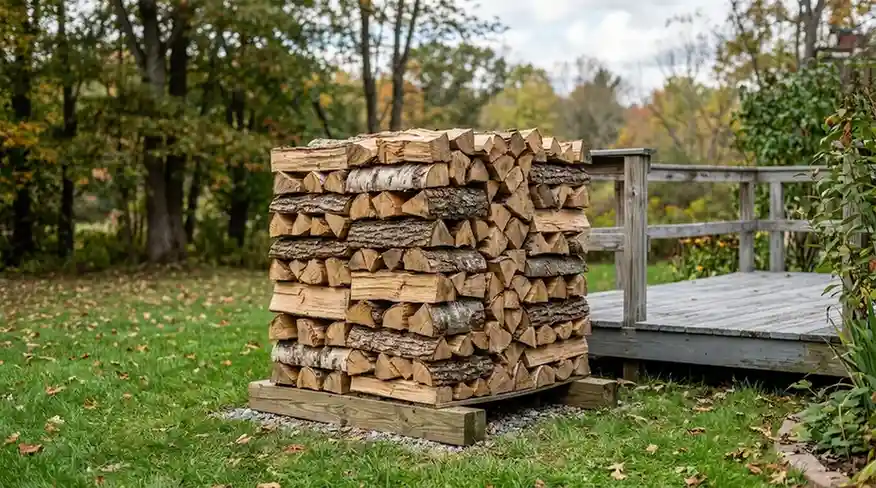
A quarter cord — 32 cubic feet of stacked wood — is the smallest standardized cord measurement. At 4 feet high × 4 feet wide × 2 feet deep (or equivalent dimensions), a quarter cord provides a modest firewood supply suitable for occasional recreational burning firewood over a few weeks.
Rick of Wood
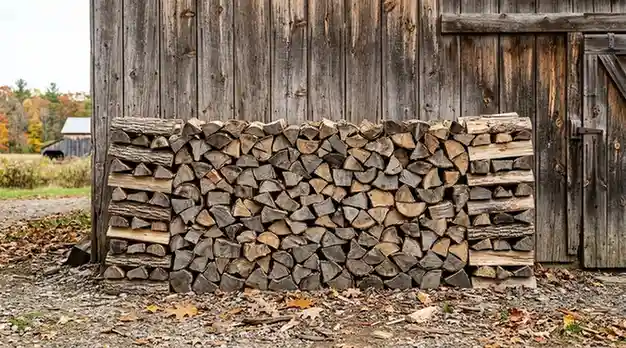
A rick of wood is the same as a face cord in most regions of the United States — a stack 4 feet high × 8 feet long, with depth equal to the piece length (typically 16 inches). The term “rick” is used more commonly in the Midwest and South, while “face cord” is more standard in the Northeast. Both refer to approximately one-third of a full cord.
Quick Answer — Face Cord vs Full Cord:
A full cord = 128 cubic feet (4×4×8 ft). A face cord = approximately 42 cubic feet (4 ft high × 8 ft long × 16 inches deep). A face cord is roughly one-third of a full cord. A rick of wood equals a face cord in most US regions.
How to Measure a Cord of Firewood
Measuring a cord of firewood is straightforward when you know what to measure — and it is a step every buyer should complete before accepting a delivery.
Measure the Stack Length
Using a tape measure, measure the total length of the stacked row from one end to the other. A full cord stack should measure 8 feet in length. A half cord measures 4 feet. A face cord also measures 8 feet in length — which is why length alone is insufficient to verify a full cord.
Measure the Stack Height
Measure the height of the stack from the ground to the top of the highest consistent row. A full cord stacks to 4 feet in height. Note that firewood stacks are rarely perfectly uniform — measure the average height across the stack rather than the tallest single point.
Measure the Stack Depth
This is the measurement that most buyers miss — and the one that makes the biggest difference in verifying a full cord. Measure the depth of the stack from front to back. This measurement equals the length of the individual split pieces.
- Full cord depth: 4 feet (48 inches) — requires pieces cut to 16 inches stacked three rows deep, or pieces cut to 48 inches in a single row
- Face cord depth: approximately 16 inches (standard piece length)
- Half cord depth: same as full cord depth, but only 4 feet long instead of 8
For standard 16-inch fireplace-length firewood, a full cord requires three rows stacked side by side, each row one piece deep (16 inches), to achieve the 4-foot (48-inch) total depth.
Calculate Cubic Volume
Once you have all three measurements, multiply them together to calculate the cubic volume:
Volume = Length × Height × Depth
For a full cord: 8 ft × 4 ft × 4 ft = 128 cubic feet ✅
If your calculation comes out significantly below 128 cubic feet, you have not received a full cord — regardless of what the supplier called the delivery.
For our complete step-by-step measurement reference, visit the dedicated guide at how to measure a firewood cord.
How Many Pieces of Wood Are in a Cord?
There is no fixed number of pieces in a cord of firewood — and any supplier who quotes you a specific piece count as the definition of a cord is either misinformed or deliberately misleading.
Why Log Count Varies
Piece count in a firewood cord depends on multiple variables that change with every delivery:
- The diameter of the original logs before splitting
- How finely each log was split
- The cut length of each piece
- The natural variation in tree diameter across different harvested logs
Two cords of firewood from the same supplier, delivered on the same day, could easily contain 400 pieces in one delivery and 700 pieces in another — and both could be accurate full cords, measured correctly at 128 cubic feet.
How Log Length Changes Quantity
Log length is the most direct variable affecting piece count in a fixed volume of firewood:
| Log Length | Approximate Pieces per Full Cord |
|---|---|
| 12 inches | 700–900+ pieces |
| 16 inches | 450–700 pieces |
| 18 inches | 400–600 pieces |
| 24 inches | 300–450 pieces |
Shorter pieces produce more individual units per cord because more cuts are made from the same volume of wood. Longer pieces produce fewer but larger individual logs.
How Splitting Affects Piece Count
Finely split firewood — pieces split into quarters or smaller from each round — produces significantly more individual pieces per cord than coarsely split wood where each round is only halved. Fine splitting is better for ignition and drying, while coarser splits burn longer and are preferred for overnight wood stove use.
The correct question to ask a firewood supplier is not “how many pieces are in a cord?” — it is “what is the cut length, and how are the pieces split?” These two questions give you the practical information you actually need.
What Affects the Amount of Wood in a Cord?
Beyond piece count, several factors directly affect how much usable wood you receive from a cord — even when the stack dimensions are correct.
Log length and species uniformity. A cord of mixed species with varied log diameters will have more air gaps than a cord of uniformly sized, uniformly split hardwood. More gaps mean less solid wood per cubic foot of stack volume.
Splitting size. Finely split wood stacks more tightly, reducing air gaps and increasing the actual solid wood content per cord. Larger, irregular splits stack with more air space between pieces.
Stacking tightness. A tightly and carefully stacked cord contains meaningfully more solid wood than a loosely arranged stack of identical dimensions. This is why reputable suppliers stack their deliveries neatly — it is both a quality signal and a measurement accuracy issue.
Green vs seasoned wood. Green firewood is heavier and sometimes stacks differently than seasoned wood. Moisture content does not affect the volume measurement of a cord, but it significantly affects the weight — a green cord of oak firewood can weigh up to 5,000 pounds, while a properly seasoned cord of the same species may weigh closer to 2,500 to 3,500 pounds.
For guidance on how to identify quality seasoned firewood from any supplier, read our identifying quality firewood guide.
How to Make Sure You’re Getting a Full Cord
Protecting yourself from a short cord delivery is simple when you know exactly what to look for and what to ask. Here is a practical, step-by-step buyer verification process:
Ask How the Wood Is Measured
Before placing any firewood order, ask the supplier directly: “Is your cord a full cord, measured as 128 cubic feet stacked?”
A reputable supplier will answer this question confidently and clearly. Vague answers (“it’s a truckload,” “it’s what everyone calls a cord around here,” or “it’s the standard amount”) are warning signs. Reputable firewood suppliers know their measurements and can state them explicitly.
Also ask: “What is the cut length of the pieces?” This tells you what depth to expect in the stack and allows you to calculate whether the delivered stack matches a full cord at that piece length.
Check Stack Dimensions
When your firewood delivery arrives, always stack the wood before measuring — loose piles cannot be accurately measured against cord dimensions. Once stacked:
- Measure the length — should be 8 feet for a full cord
- Measure the height — should be 4 feet for a full cord
- Measure the depth — should match the piece length; for a full cord at 16-inch pieces, depth should be approximately 4 feet (three rows of 16-inch pieces)
- Multiply all three — should equal approximately 128 cubic feet
If the result is significantly below 128 cubic feet, you have received a short cord and should contact your supplier immediately.
Understand Log Length
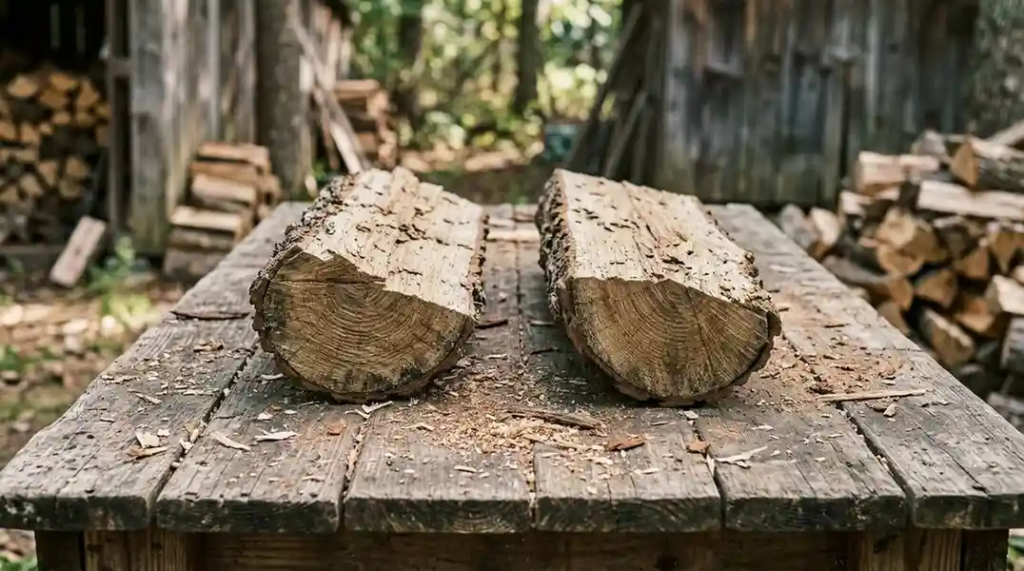
Log length is the variable that catches the most buyers off guard. Many buyers assume that a face cord — 4 feet high × 8 feet long × 16 inches deep — is a full cord because two of the three dimensions match. It is not. It is approximately one-third of a full cord.
Confirm the piece length with your supplier before delivery and use that length as your depth measurement when verifying the stack. At 16-inch piece length, a full cord requires a stack approximately 4 feet deep (three rows). At 24-inch piece length, a full cord requires a stack approximately 4 feet deep (two rows of 24 inches each).
Watch for Excessive Gaps
Even when stack dimensions are technically correct, excessive gaps between pieces reduce the actual solid wood content of a cord. A cord stacked loosely — with large, irregular air spaces between crooked or oversized pieces — contains less real firewood than the stack dimensions suggest.
When evaluating a delivery, look for:
- Uniform, consistently sized split pieces
- Tightly stacked rows with minimal visible gaps
- Pieces of similar length throughout the stack
- No large, round unsplit sections hidden in the middle of the stack
A well-prepared cord of firewood from a professional supplier looks neat, consistent, and tight — not like a random pile of whatever fit on the truck. 12 Point Farms LLC prepares every delivery to meet our accurate measurement standard from the first piece stacked to the last.
How Much Does a Cord of Firewood Cost?
Firewood cord pricing is not the focus of this guide — but it is a practical consideration for buyers comparing quantities and planning their seasonal budget.
Cord pricing varies based on several factors:
- Wood species — dense hardwoods like oak and hickory command higher prices than lower-density species due to their superior heat output and longer burn time
- Preparation method — kiln-dried firewood typically costs more than conventionally seasoned wood due to the additional processing involved
- Geographic region — prices vary significantly by location and local wood availability
- Delivery distance — delivery fees add to the base cord price depending on your distance from the supplier
- Season and demand — peak winter demand typically pushes prices higher than off-season ordering
For a detailed breakdown of firewood pricing factors and what to expect when budgeting for a season’s supply, visit our dedicated resource: how much does a cord of wood cost?
Buyer tip: Ordering in the off-season — spring or early summer — typically secures better pricing and guarantees availability before peak winter demand reduces supply. It also gives any newly delivered wood additional time to season before the heating season begins.
Choosing the Right Amount of Firewood
Knowing what a cord is helps — but knowing how much you actually need is the question that saves you from ordering too little or paying for more than you will use.
Here is a practical reference guide for estimating seasonal firewood needs by use type:
| Use Type | Estimated Annual Need |
|---|---|
| Occasional recreational fireplace | ¼ to ½ cord |
| Regular weekend fireplace use | ½ to 1 cord |
| Supplemental home heating | 1 to 2 cords |
| Primary wood stove heating (small home) | 2 to 3 cords |
| Primary wood stove heating (large home) | 3 to 5 cords |
| Commercial/restaurant wood-fired oven | Varies — consult supplier |
| Campground or outdoor event use | Varies by frequency |
Variables that affect your seasonal estimate:
- Climate severity — colder winters require more wood for the same heating result
- Home insulation quality — well-insulated homes retain heat longer and require fewer reloads
- Firewood species — dense hardwood like oak burns significantly longer per load than lower-density species, reducing total cord consumption for equivalent heat output
- Appliance efficiency — high-efficiency wood stoves extract more heat per log than open fireplaces, reducing total firewood consumption
- How often you actually use the fireplace — an estimate based on daily use will significantly overstate needs for someone who burns only on weekends
For first-time buyers: ordering a half cord initially is a sensible approach. It gives you real-world data on your actual consumption rate without committing to a quantity you may not use — and it lets you evaluate your supplier’s quality and measurement accuracy before scaling up.
If you are comparing firewood quantities before placing your first order, explore our available firewood products and sizing options to find the right cord size for your specific needs.
Frequently Asked Questions
What is a cord of firewood?
A cord of firewood is a standardized unit of measurement equal to 128 cubic feet of tightly stacked wood. A full cord measures 4 feet high × 4 feet wide × 8 feet long. It contains approximately 80 to 90 cubic feet of actual solid wood, with the remainder being natural air space between stacked pieces. The cord is the most widely recognized and legally defined firewood quantity in the United States.
How big is a full cord of firewood?
A full cord of firewood measures exactly 4 feet high × 4 feet wide × 8 feet long, totaling 128 cubic feet of stacked volume. Visualize it as a stack 8 feet long and 4 feet tall, with pieces stacked 4 feet deep from front to back. It is substantially larger than a single pickup truck load and requires dedicated outdoor storage space of at least 8 feet by 4 feet.
How many cubic feet are in a cord of wood?
A cord of wood contains 128 cubic feet of stacked volume. Approximately 80 to 90 cubic feet of that is actual solid wood. The remaining 38 to 48 cubic feet is air space between the stacked pieces — a natural result of the irregular shapes of split firewood that cannot be eliminated regardless of how carefully the wood is stacked.
How many pieces of firewood are in a cord?
There is no fixed piece count in a cord of firewood. The number varies based on log length, splitting size, species, and log diameter. A cord of 16-inch split hardwood typically contains between 400 and 700 individual pieces — but this range is approximate. Volume measured in cubic feet is the only reliable way to define and verify a cord of firewood.
What is the difference between a full cord and a face cord?
A full cord measures 4 ft × 4 ft × 8 ft = 128 cubic feet. A face cord measures 4 ft high × 8 ft long × approximately 16 inches deep = roughly 42 to 43 cubic feet. A face cord is approximately one-third of a full cord in actual wood volume. They look identical when viewed from the front because both are 4 feet tall and 8 feet long — the depth measurement is the critical difference.
How do you measure a cord of firewood?
Stack the wood neatly, then measure three dimensions: length, height, and depth. Multiply all three together to calculate cubic volume. A full cord should equal 128 cubic feet: 8 ft × 4 ft × 4 ft = 128. Always stack before measuring — loose piles cannot be accurately measured against cord dimensions.
How much does a cord of firewood weigh?
A cord of firewood weighs between 2,000 and 5,000 pounds depending on species and moisture content. Dense, green hardwood like oak at the high end of moisture can weigh close to 5,000 pounds per cord. Properly seasoned hardwood of the same species typically weighs between 2,500 and 3,500 pounds per cord. Kiln-dried firewood weighs less than seasoned wood at the same species due to lower moisture content.
Does log length change the amount of wood in a cord?
Log length changes the piece count in a cord but not the total volume. A cord of 12-inch pieces contains more individual pieces than a cord of 24-inch pieces — but both occupy 128 cubic feet of stacked volume. Log length does affect how deep the stack needs to be to achieve a full cord: at 16-inch pieces, you need approximately 4 feet of depth (three rows); at 24-inch pieces, approximately 4 feet of depth (two rows).
How can I tell if I received a full cord?
Stack the delivered wood neatly and measure the height, length, and depth of the stacked pile. Multiply the three measurements together. The result should equal approximately 128 cubic feet for a full cord. If the number is significantly lower, you received a short cord. Also confirm the piece length with your supplier before delivery so you know what depth to expect in the stack.
Is a rick the same as a cord of firewood?
No. A rick — also called a face cord — is approximately one-third of a full cord. A rick typically measures 4 feet high × 8 feet long × 16 inches deep, totaling roughly 42 to 43 cubic feet of stacked wood. The full cord, at 128 cubic feet, is three times the volume of a standard rick. In some regions, “rick” is used loosely to mean different quantities — always confirm dimensions with your specific supplier.
How much firewood do I need for a season?
Seasonal firewood needs vary by use type. Occasional recreational fireplace users typically need ¼ to ½ cord per season. Regular weekend burners need ½ to 1 cord. Homeowners using a wood stove as a supplemental heat source need 1 to 2 cords. Primary wood stove heating for a typical home requires 2 to 5 cords depending on home size, insulation, climate, and wood species used.
How much does a cord of firewood cost?
Cord pricing varies significantly by region, species, preparation method, and season. Dense hardwood species cost more than lower-density options. Kiln-dried firewood commands a premium over conventionally seasoned wood. Delivery distance adds to the base price. For a full pricing breakdown, visit our guide on how much does a cord of wood cost.
Additional Firewood Resources From 12 Point Farms LLC
Measurements and Quantities:
- How to Measure a Firewood Cord — Step-by-step measurement reference
- Full Cord Firewood — Full cord sizing, storage, and ordering
- Half Cord Firewood — Half cord guide for supplemental heating
- Understanding Firewood Bundles — Bundle sizing vs cord comparison
- How Much Does a Cord of Wood Cost? — Firewood pricing guide
- Bulk Firewood — Large volume ordering guidance
Buying and Quality:
- Identifying Quality Firewood — What to look for before you buy
- Firewood Moisture Content Guide — Why moisture content matters
- Choosing Hardwood vs Softwood Firewood — Species comparison guide
- Best Wood for Firewood — Top hardwood species by performance
Storage and Stacking:
- Properly Stacking Firewood — Correct stacking for measurement and dryness
- Firewood Storage Tips — Complete seasonal storage guide
- Firewood Seasoning Time — How long firewood takes to dry by species
By Application: