Firewood for Heating Home: The Complete Guide to Stay Warm This Winter 2026-2027
Firewood for Heating Home: Best BTU & Cord Guide
Firewood for Heating Home works best with dense hardwoods like oak and hickory at 20% moisture or lower — 12 Point Farms LLC breaks down BTU ratings, cord needs, and seasoning here.
Winters are getting colder every year, and nothing beats the cozy warmth and comforting crackle of a real wood fire in your home. But not all firewood is the same — some burn fast and give little heat, while others keep your home warm for hours and save you money. If you’re looking for the best firewood for heating home, this guide will walk you through the exact BTU ratings, moisture levels, how many cords you’ll need, and simple tips to get maximum heat and efficiency from your fireplace or wood stove. Let’s find out which firewood is perfect for your home.
There’s a specific kind of silence that happens during a heavy snowfall — a quiet that makes you want to retreat inward, wrap your hands around a warm mug, and watch the flakes drift past the window.
But that peace is hard to find if you’re constantly listening for the loud thrum of a furnace, or worse, worrying about the mounting cost of the electric bill.
At 12 Point Farms LLC, we believe that firewood for heating your home isn’t just about BTUs or thermal dynamics. It’s about a connection to the land, a sense of self-reliance, and a quality of warmth that a thermostat simply can’t replicate.
If you’ve been considering making the switch — or if you’re a seasoned “wood burner” looking to refine your craft — let’s talk about what it really means to live by the rhythm of the woodpile.
The True Cost: More Than Just Dollars and Cents
When people ask about the cost of firewood, they usually want to know if it’s cheaper than propane or heating oil. The short answer? Yes. But the real answer is more personal.
Escaping the Monthly “Bill Anxiety”
We’ve all been there: staring at a utility bill in January and wondering how the numbers got that high. When you heat with wood, you take back control. You buy your fuel upfront. You see it stacked neatly in your yard. There are no “peak hour” surcharges or global market spikes.
The Value of “Sweat Equity”
There is a profound satisfaction in the work. When you spend a Saturday morning stacking a fresh delivery from 12 Point Farms LLC, you aren’t just “doing a chore.”
You’re investing in your own comfort. You’re getting exercise, breathing fresh air, and looking at a tangible wall of security that will keep your family safe all winter. That kind of “sweat equity” pays dividends in peace of mind that a direct-deposit utility payment never will.
Firewood for Heating Home: Efficiency – The Art of the Perfect Burn
“Efficiency” sounds like a cold, corporate word, but in the world of firewood, it’s an art form. It’s the difference between a smoky, frustrating evening and a bright, roaring fire that lasts until morning.
The Life Cycle of a Log
To get the most out of your firewood for heating home, you have to respect the wood. We often see folks trying to burn wood that’s still “green” — wood that was standing in a forest just a few months ago.
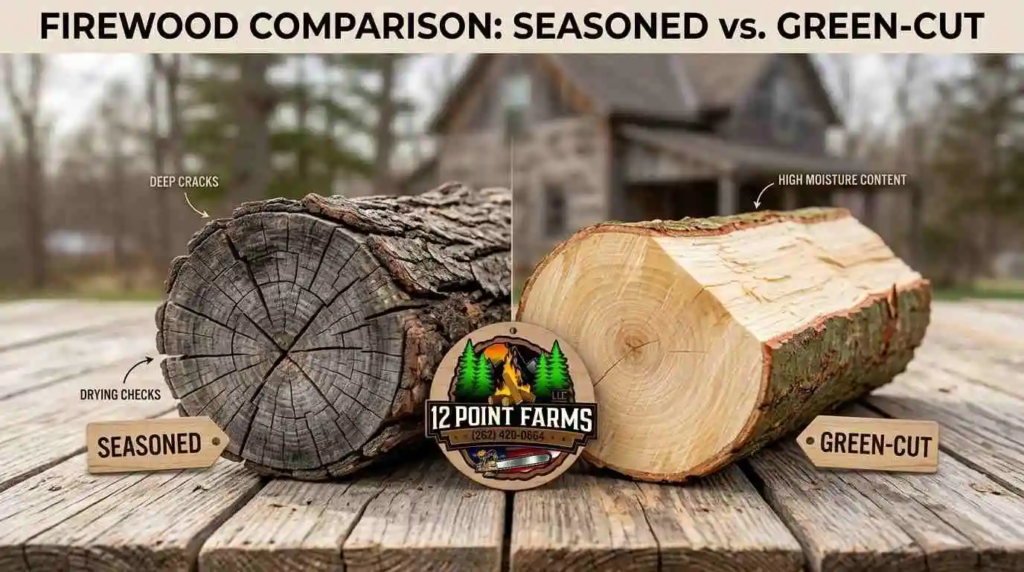
Think of it this way: if you try to burn wet wood, the fire has to spend all its energy boiling that water away before it can start heating your room. You’ll see it hissing and bubbling at the ends of the logs. That’s the sound of heat escaping.
What “seasoned” actually means: properly seasoned firewood has a moisture content of 20% or lower. Green, freshly cut wood can sit at 50-60% moisture. Getting from green to seasoned isn’t instant — most hardwoods need 6 to 12 months of proper drying time (split, stacked, and exposed to sun and wind) before they’re ready to burn efficiently. Softwoods can season faster, sometimes in 3 to 6 months. A simple moisture meter (available for under $20) takes the guesswork out — just press the pins into a freshly split face of the log and check the reading before you stack it in your rack.
Our seasoned wood at 12 Point Farms LLC has been given the time it needs to “cure,” meaning the moisture has evaporated, leaving behind nothing but pure, combustible energy.
The Firewood BTU Chart: Which Wood Actually Burns the Hottest?
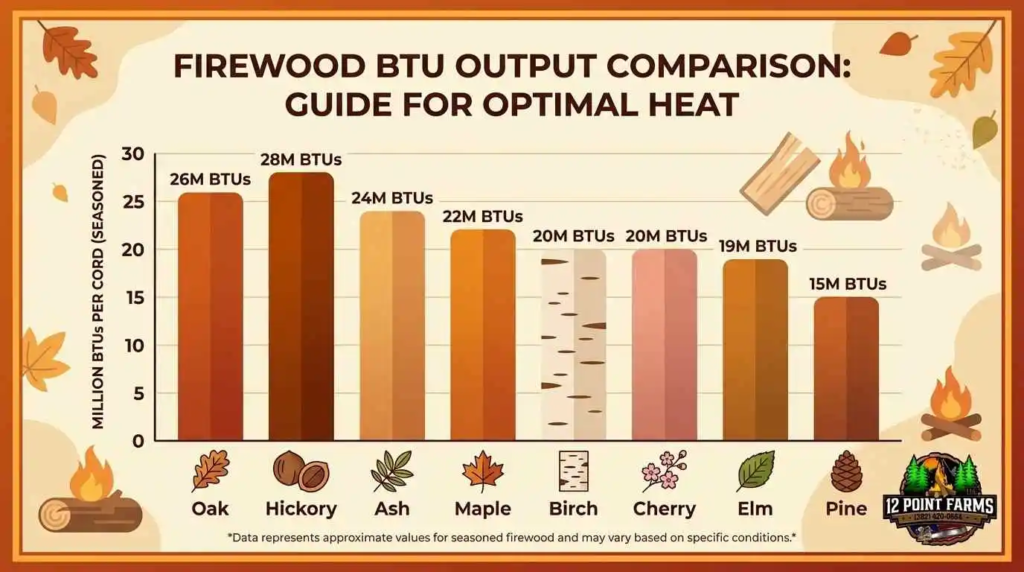
If you want a real, numbers-based answer to “what’s the best firewood for heating home,” it comes down to BTUs (British Thermal Units) — the amount of heat energy a cord of wood can produce. Denser hardwoods pack more energy per log, which means longer, hotter burns and fewer trips out to the woodpile at 2 AM.
| Wood Type | Approx. BTUs per Cord (millions) | Burn Character |
|---|---|---|
| Hickory | 24.6 – 27.7 | Very hot, very long burn |
| Oak (Red/White) | 24.0 – 29.1 | Dense, slow, excellent coal bed |
| Ash | 23.6 – 24.2 | Steady heat, splits easily |
| Sugar Maple | 21.3 – 24.0 | Balanced heat, sweet aroma |
| Birch | 20.8 – 26.8 | Fast, hot start, burns quicker |
| Cherry | 20.4 – 20.8 | Quick ignition, pleasant smell |
| Elm | 19.5 – 20.1 | Moderate heat, can be smoky if damp |
| White Pine | 14.0 – 15.9 | Fast, hot start; best for kindling or shoulder-season fires |
(Figures are approximate industry averages and vary with tree age, region, and moisture content.)
How to read this chart practically:
- For an all-night, hold-the-heat-till-morning fire → go with Oak or Hickory.
- For a quick, fragrant fire to take the chill off → Maple or Cherry lights fast and smells great.
- For easy splitting and dependable, steady heat → Ash is hard to beat, and it’s one of the few woods that burns reasonably well even slightly green (though we still recommend seasoning it first).
Want the deeper dive on any single species? We’ve broken each one down separately — check out our full guides on Oak firewood benefits, Ash firewood properties, and Maple firewood qualities.
Hardwood: The Marathon Runner of the Forest
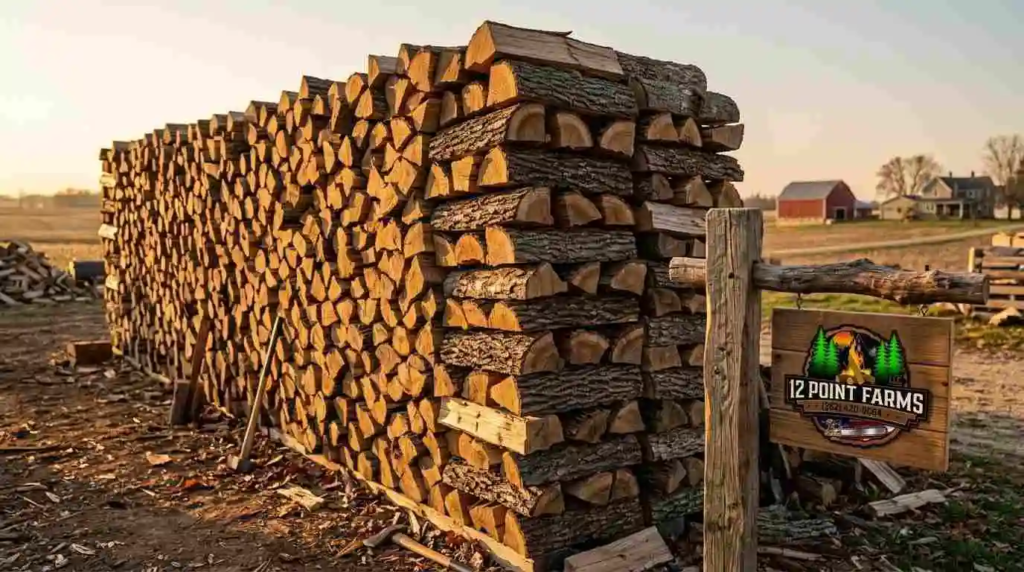
If Pine is a sprinter — burning hot and fast to get the chill out of the air — Oak and Hickory are the marathon runners.
For a long, slow burn that carries you through a 2:00 AM cold snap, you want the dense hardwoods. They leave behind a bed of glowing coals that act like a thermal battery, radiating heat long after the flames have died down. That’s exactly why our Mixed Hardwood cords are built around species like oak, hickory, and ash — the ones that actually deliver on a cold Wisconsin night.
How Many Cords of Firewood Do You Actually Need?
This is one of the most common questions we get at the yard, and the honest answer is: it depends on your setup. But here’s a working guide to help you plan your season instead of guessing:
- Primary heat source (wood stove is your main heat): roughly 3 to 5 cords for the season, depending on climate and home size.
- Supplemental heat (fireplace used most evenings): roughly 1.5 to 3 cords.
- Occasional/ambiance fires (weekends, holidays): roughly 0.5 to 1 cord.
Other factors that shift these numbers: how well-insulated your home is, how cold your specific winter runs, the efficiency of your stove or insert, and which wood species you’re burning (denser hardwood = fewer cords needed for the same heat output).
Not sure where you land? That’s exactly the kind of thing we talk through with customers every day — give us a call, and we’ll help you estimate the right amount before the first frost hits.
Firewood for Heating Home: Why Wood Heat “Feels” Better
We talk a lot about “radiant heat” in the industry, but let’s describe what that actually feels like.
Forced-air heating is like a hairdryer — it blows hot air at you, dries out your skin, and disappears the moment the fan stops. Wood heat is like a hug. It’s a heavy, penetrating warmth that soaks into the floorboards, the back of your sofa, and your very bones.
There is also the soul of it. A wood stove is the heartbeat of a home. It’s where the dog sleeps, where the kids dry their mittens after sledding, and where the best conversations happen. You don’t gather around a radiator to tell stories; you gather around a fire.
The Reality Check: It’s a Partnership
We’ll be the first to tell you: heating with wood is a lifestyle. It’s not “set it and forget it.” It requires a bit of planning and a little bit of dirt on your boots.
- The Ritual: You’ll learn the language of your stove — the way the dampers click, the sound of the draft, and the smell of a perfectly seasoned Oak firewood log.
- The Safety: Burning unseasoned or wet wood doesn’t just waste heat — it builds up creosote, a tar-like residue that coats your chimney flue and is the leading cause of chimney fires. Dry, well-seasoned wood burns cleaner and produces far less of it. You have to take care of your chimney like you take care of your car: an annual professional sweep and inspection isn’t just a recommendation; it’s how you keep your family safe. A working carbon monoxide detector near your stove or fireplace is non-negotiable too.
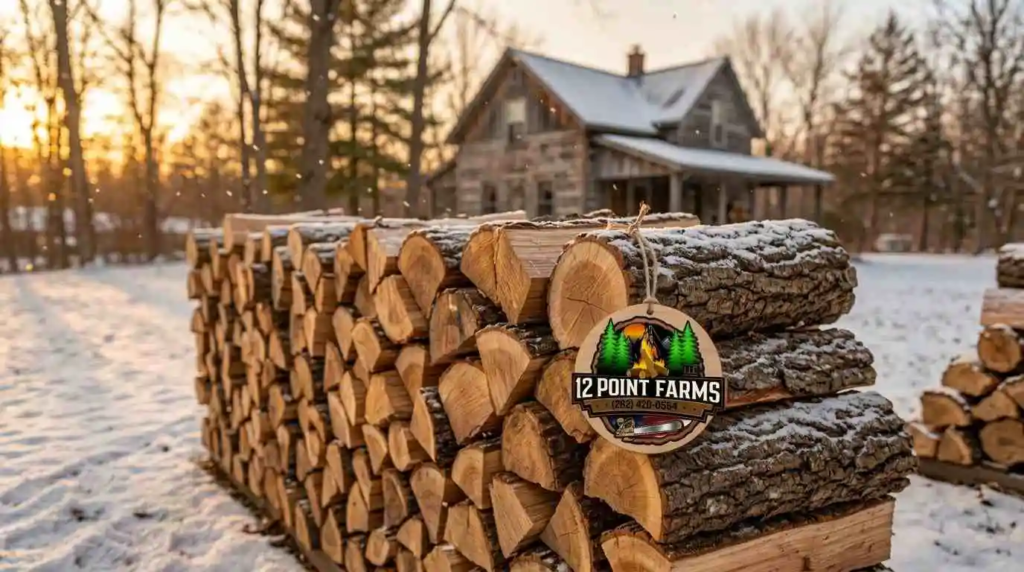
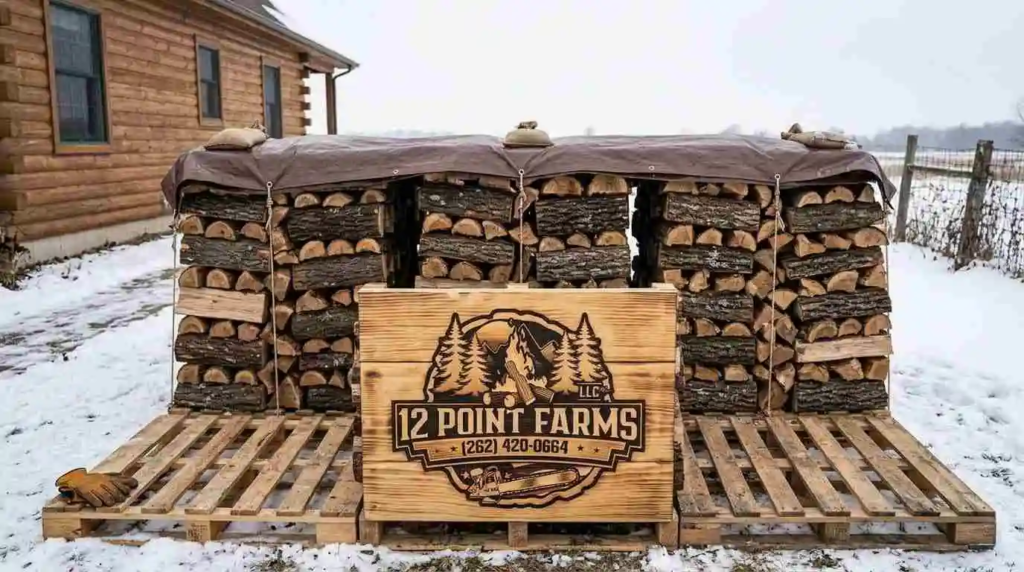
- The Storage: Your woodpile is your pantry, and how you keep it matters. Stack your wood off the ground (on pallets or a rack) so air can circulate underneath and moisture doesn’t wick up from the soil. Keep rows a few inches apart for airflow; cover the top only with a tarp so rain and snow stay out, but the sides can still breathe, and if possible, position your stack a safe distance from the house with the bark side facing up to shed water. Keeping it covered and high-and-dry ensures that when the blizzard hits, you aren’t fighting with frozen, soggy logs.
Kiln-Dried vs. Seasoned Firewood: Which Should You Choose?
Both give you low-moisture, efficient-burning wood — the difference is in how they get there.
- Seasoned (air-dried) firewood is cut, split, and left to dry naturally over several months to a year. It’s the traditional, most economical option, and when done right (like ours), it burns just as cleanly.
- Kiln-dried firewood is dried in a controlled kiln over a shorter period, bringing moisture content down fast and consistently — often below 20% every single time, with the added benefit of killing off any pests or fungal spores in the wood. It’s a great choice if you need reliably dry wood in a hurry, or if you’re burning indoors frequently and want the most consistent, low-smoke fire possible.
We carry both at 12 Point Farms — browse our full lineup, including Kiln-Dried Firewood, Mixed Hardwood cords, Campfire Bundles, and Fire Starter Kits, to find the right fit for your stove and your schedule.
Firewood for Heating Home: Sustainability – Giving Back to the Earth
At 12 Point Farms LLC, we aren’t just clearing land; we’re managing a resource. Firewood is one of the few truly renewable ways to heat a home.
When trees are harvested responsibly, they make room for new growth that breathes in carbon dioxide, continuing a cycle that has sustained humanity for millennia. When you burn wood, you’re participating in a natural process, not digging up ancient carbon from deep underground.
Locally Sourced, Locally Delivered
Everything you’ve just read isn’t theory to us — it’s how we run our wood yard in Hartford, WI, serving Washington County and communities across Wisconsin. When you order a cord from 12 Point Farms, you’re getting wood that was cut, split, and seasoned right here, not trucked in from three states away. That’s part of what makes it burn better: shorter time between the yard and your rack means we can guarantee the moisture content, not just promise it.
Let’s Get You Ready for Winter
Choosing firewood for heating home use is a return to something honest. It’s about knowing where your heat comes from and being the one who provides it for your family.
Whether you’re a first-timer with a brand-new insert or a lifelong wood-burner with a favorite splitting maul, we’re here to make sure your woodpile is the envy of the neighborhood. We don’t just drop off a load of wood; we deliver the ingredients for your best winter yet.
A Quick Cheat-Sheet for Your Hearth
| If you want… | Choose this wood… | Because… |
|---|---|---|
| An all-night burn | Oak or Hickory | High density = longer fire, best BTU output |
| A quick morning warm-up | Birch or Cherry | Ignites faster and smells amazing |
| A cozy “crackle” with easy splitting | Ash | Low moisture, splits clean, steady heat |
| Balanced heat with a sweet aroma | Maple | Good middle-ground density and BTU |
| Kindling or a fast shoulder-season fire | Pine | Lights quickly, best used for starting fires, not overnight heat |
Is your wood rack looking a little empty? Don’t wait for the first frost to find out you’re short on fuel. Give us a call at 12 Point Farms LLC.
We’d love to talk about your stove setup, help you estimate how many cords you’ll need, and get you on the schedule for a delivery that will keep you toasty all season long.
Frequently Asked Questions
What is the best firewood for heating a home?
Dense hardwoods like oak, hickory, and ash top the list for home heating because they have the highest BTU output per cord and leave behind long-lasting coal beds. Softer woods like pine and birch are better for quick starts than sustained overnight heat.
How long does it take firewood to season?
Most hardwoods need 6 to 12 months of proper drying (split, stacked, and exposed to air) to reach the ideal moisture content of 20% or lower. Softwoods can season in as little as 3 to 6 months.
How much firewood do I need for winter?
If wood is your primary heat source, plan on 3 to 5 cords for the season. If it’s supplemental heat, 1.5 to 3 cords is typical. Ambiance-only burners usually need less than a cord.
Is kiln-dried or seasoned firewood better for heating?
Both burn efficiently when properly dried. Kiln-dried wood offers guaranteed low moisture and pest-free wood faster; seasoned firewood is the traditional, economical option and burns just as well when given enough time.
Why is my firewood hissing or smoking a lot?
That’s a sign the wood is still too wet (green or under-seasoned). The fire is burning off moisture instead of producing clean heat, and it also contributes to creosote buildup in your chimney.