
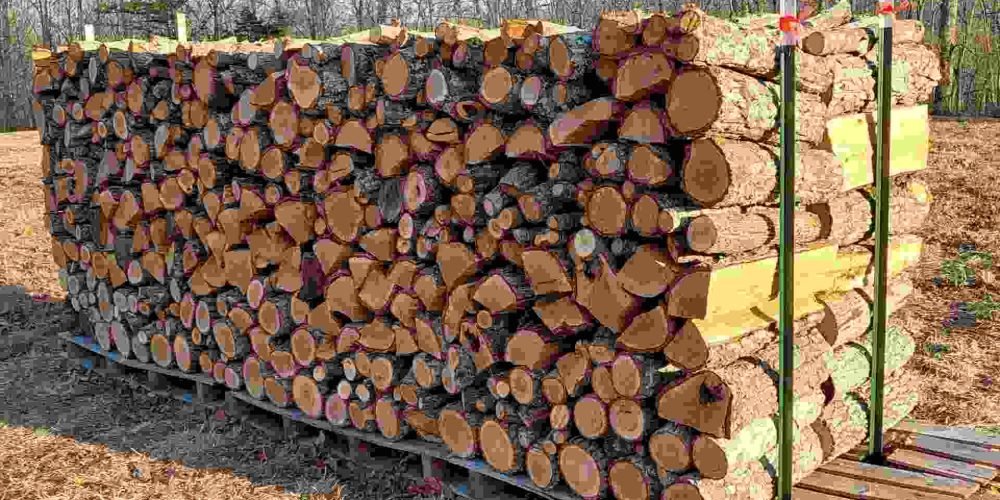
Full Cord Firewood: How Much Wood Is in a Full Cord?
A full cord of firewood contains 128 cubic feet of tightly stacked wood — measuring exactly 4 feet high × 4 feet wide × 8 feet long. It is the standard legal firewood measurement in the United States and the most widely recognized unit for buying, selling, and comparing firewood quantities.
If you have ever searched “how much wood is in a full cord” or wondered whether a delivered stack actually represents what you paid for, this guide gives you every answer you need — from exact dimensions to measurement verification, cord comparisons, usage estimates, and proper storage.
At 12 Point Farms LLC, we measure every delivery accurately and stand behind every cord we sell. Understanding exactly what a full cord means puts you in control of every firewood purchase you make.
What Is a Full Cord of Firewood?
A full cord = 128 cubic feet of stacked wood. Dimensions: 4 ft high × 4 ft wide × 8 ft long. It contains approximately 80–90 cubic feet of solid wood, with the remainder being natural air space between pieces. It is the standard US firewood measurement unit.
What Is a Full Cord of Firewood?
What Does “Full Cord” Mean?
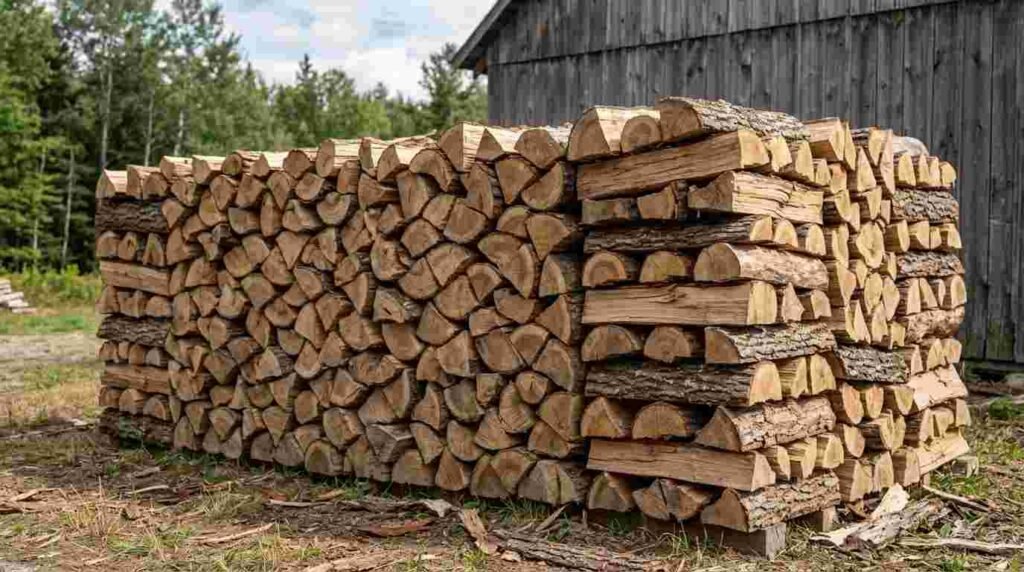
A full cord is the standard unit of firewood measurement recognized across the United States. It represents a specific, measurable volume of stacked wood — not an estimate, not a truckload, and not a loose pile.
The word “full” distinguishes it from partial measurements like a face cord or half cord — both of which are fractions of the full cord volume but are sometimes sold without that distinction being made clearly.
In most US states, the cord is legally defined. Selling firewood in quantities described as “cords” without meeting the standard dimensions is a consumer protection violation in many jurisdictions.
How Much Wood Is in a Full Cord?
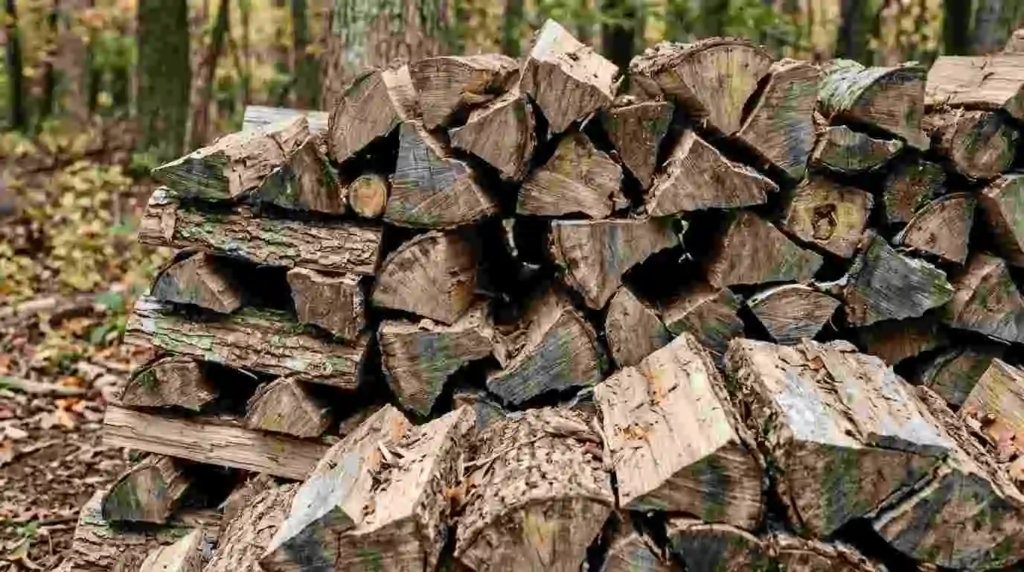
A full cord contains 128 cubic feet of stacked volume — but not 128 cubic feet of solid wood.
Because split firewood pieces are irregular in shape, air gaps exist between every piece in the stack. Those gaps are unavoidable and are part of the cord measurement standard.
Here is what a full cord actually contains:
| Component | Volume |
|---|---|
| Total stacked volume | 128 cubic feet |
| Solid wood content | ~80–90 cubic feet |
| Air space between pieces | ~38–48 cubic feet |
The tighter and more uniformly the wood is stacked, the more solid wood is contained within the 128 cubic feet. Loose, irregular stacking reduces the actual wood content even when the overall dimensions look correct.
What Are the Dimensions of a Full Cord?
Standard Full Cord Measurements
A full cord has three fixed dimensions:
| Dimension | Measurement |
|---|---|
| Height | 4 feet |
| Width (depth) | 4 feet |
| Length | 8 feet |
| Total volume | 4 × 4 × 8 = 128 cubic feet |
Visualizing it: a full cord stacked against a wall would be 8 feet long, 4 feet tall, and 4 feet deep from front to back. That is roughly the size of a standard interior doorway in height and width, extended 8 feet along a wall.
A standard pickup truck bed does not hold a full cord. A typical pickup carries approximately one-third to one-half of a cord depending on truck size and how the wood is loaded. Any seller claiming a single pickup load equals a full cord should be asked to verify the stack dimensions after delivery.
Understanding 128 Cubic Feet of Wood
The 128 cubic feet measurement represents the total occupied space of the stack — not the solid wood alone.
Why this matters: Two stacks can both measure 128 cubic feet but contain different amounts of actual solid wood depending on:
- How tightly the pieces are packed
- How uniformly the wood is split
- Whether pieces are stacked neatly or loosely arranged
A neatly hand-split, uniformly sized cord contains more usable wood per 128 cubic feet than a loosely arranged pile of the same labeled volume. This is one reason quality firewood suppliers invest in consistent splitting and careful stacking — it directly affects the value you receive.
How Is a Full Cord of Firewood Measured?
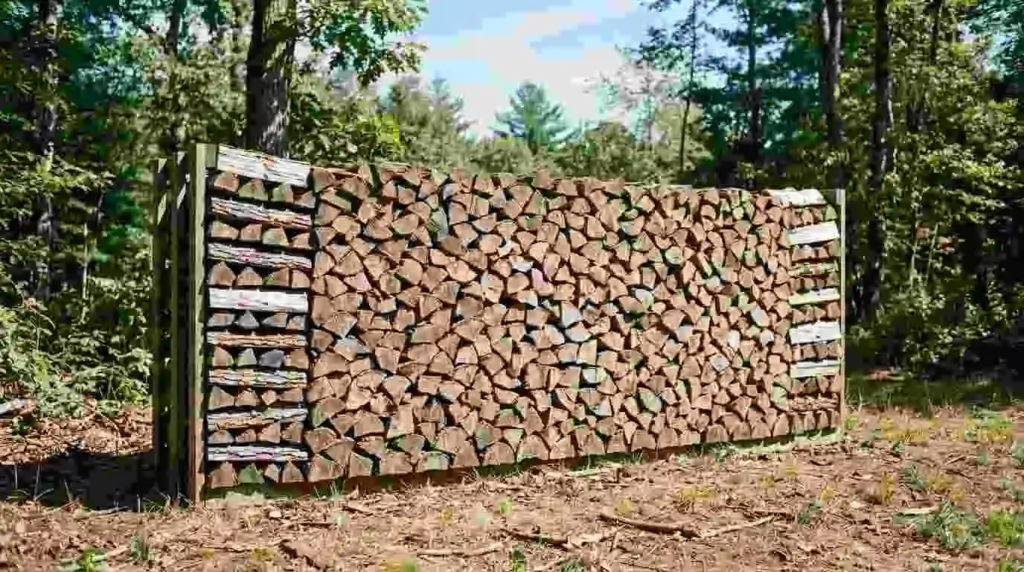
Measuring the Length, Height, and Width
Measuring a full cord is straightforward when you know what to check. Always stack the wood neatly before measuring — a loose pile cannot be accurately compared against cord dimensions.
Once stacked, measure three dimensions:
Length: Measure the total horizontal length of the stack from end to end. A full cord stack measures 8 feet in length.
Height: Measure from the ground to the top of the consistently stacked row. A full cord stack measures 4 feet in height.
Width (Depth): Measure the depth of the stack from the front face to the back. This equals the length of the individual split pieces — typically 16 inches for standard fireplace wood.
Important: Width is the measurement most buyers miss — and the one that most often reveals a short delivery.
Why Log Length Affects the Stack
Standard fireplace-length pieces run approximately 16 inches. A full cord using 16-inch pieces requires approximately three rows of pieces stacked side by side to achieve the 4-foot (48-inch) total depth.
If pieces are cut to 24 inches, two rows achieve the 4-foot depth. If pieces are cut shorter — 12 inches — you need four rows.
The piece length determines how many rows are needed to reach a full cord depth. Always confirm the cut length with your supplier before delivery so you know exactly what depth to expect in the stack.
| Piece Length | Rows Needed for 4 ft Depth |
|---|---|
| 12 inches | ~4 rows |
| 16 inches | ~3 rows |
| 24 inches | ~2 rows |
| 48 inches | 1 row |
How to Calculate Firewood Volume
Once you have all three measurements, the calculation is simple:
Volume = Length × Height × Depth
Full cord check: 8 ft × 4 ft × 4 ft = 128 cubic feet ✅
If your calculation returns significantly less than 128 cubic feet after stacking, you have received less than a full cord — regardless of what the supplier described the delivery as.
For a complete step-by-step measurement walkthrough, visit our dedicated how to measure a firewood cord guide.
Full Cord vs. Face Cord vs. Rick
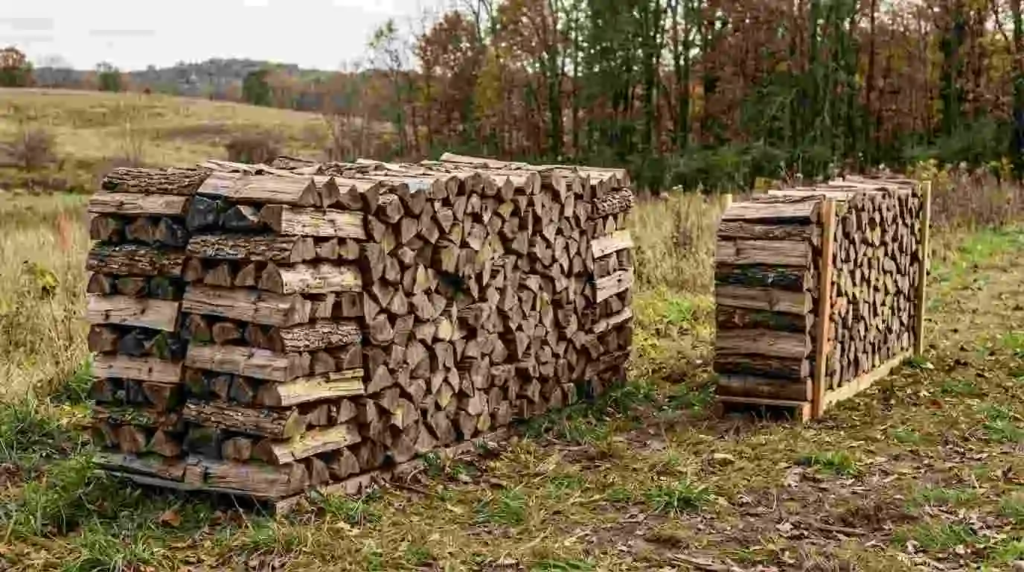
This comparison is the most important one for any firewood buyer to understand — because confusion between these terms is where most quantity disputes begin.
What Is a Face Cord?
A face cord looks like a full cord from the front — it measures 4 feet high and 8 feet long, identical to a full cord in those two dimensions. The critical difference is depth.
A face cord is only as deep as the length of the individual split pieces — typically 16 inches. That makes a face cord approximately:
4 ft × 8 ft × 1.33 ft = 42.6 cubic feet
That is roughly one-third of a full cord. A buyer who orders a “cord” and receives a face cord has received approximately 33% of the wood volume they paid for.
What Is a Rick of Firewood?
A rick is the same as a face cord in most US regions — approximately 42 cubic feet of stacked wood, measuring 4 feet high × 8 feet long × 16 inches deep.
The term “rick” is more common in the Midwest and South. “Face cord” is more standard in the Northeast. Both refer to one-third of a full cord. In some regions, “rick” is used loosely to mean different quantities — always confirm actual dimensions with your supplier.
How These Measurements Differ From a Full Cord
| Type | Dimensions | Volume | % of Full Cord |
|---|---|---|---|
| Full Cord | 4 ft × 4 ft × 8 ft | 128 cu ft | 100% |
| Half Cord | 4 ft × 4 ft × 4 ft | 64 cu ft | 50% |
| Face Cord / Rick | 4 ft × ~16 in × 8 ft | ~43 cu ft | ~33% |
| Quarter Cord | 4 ft × 4 ft × 2 ft | 32 cu ft | 25% |
How Much Firewood Do You Actually Need?
Factors That Affect Firewood Usage
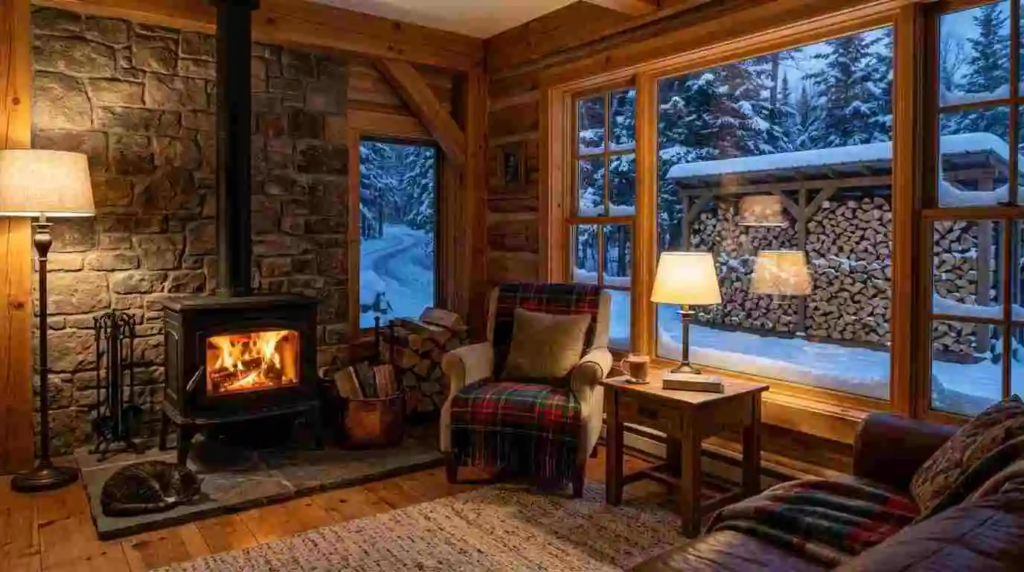
No two households burn through firewood at the same rate. The variables that affect your seasonal consumption most directly are:
- How often you use your fireplace or wood stove — daily versus occasional weekend use
- Whether wood is your primary heat source or supplemental — primary users burn significantly more
- Your home’s insulation quality — well-insulated homes retain heat longer and require fewer reloads
- The wood species you are burning — dense hardwoods like oak burn longer per load than lower-density species
- The severity of your local winter — Wisconsin winters demand more wood than milder climates
- The efficiency of your heating appliance — high-efficiency wood stoves extract more heat per log than open fireplaces
Fireplace vs. Wood Stove Usage
Open fireplaces are less efficient than enclosed wood stoves. More heat escapes up the flue, and fires typically burn for shorter durations before needing reloading. Homeowners using an open fireplace primarily for ambiance typically need less total wood than those using a wood stove for heating.
High-efficiency wood stoves extract a greater percentage of each log’s stored energy as usable room heat. A well-loaded wood stove using quality dense hardwood requires fewer reloads and burns through fewer cords per season than an open fireplace providing equivalent warmth.
How Long a Full Cord May Last
| Use Type | Estimated Seasonal Need | Full Cords Required |
|---|---|---|
| Occasional recreational fireplace | Light | ¼ to ½ cord |
| Regular weekend fireplace or fire pit | Moderate | ½ to 1 cord |
| Supplemental home heating | Moderate–Heavy | 1 to 2 cords |
| Primary wood stove, small home | Heavy | 2 to 3 cords |
| Primary wood stove, larger home | Very Heavy | 3 to 5 cords |
These are estimates based on general usage patterns. Your actual consumption will depend on the specific variables listed above. First-time buyers typically benefit from starting with a half cord to establish their real burn rate before committing to a larger seasonal order.
What Type of Firewood Is Best for Heating?
Hardwood vs. Softwood
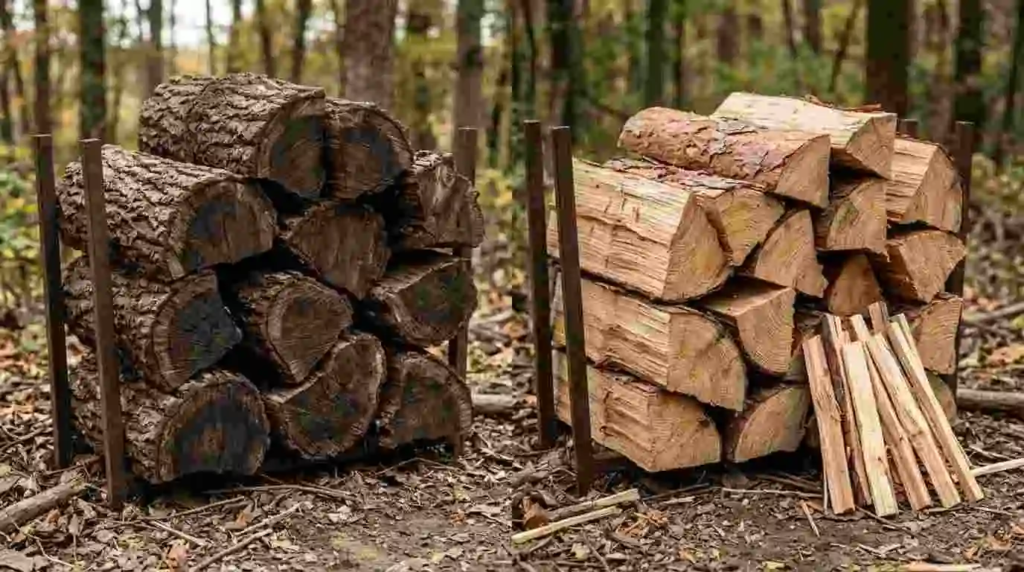
For home heating — whether in a fireplace, wood stove, or fire pit — hardwood consistently outperforms softwood in every relevant metric.
Hardwood species like oak, hickory, and maple are significantly denser than softwoods like pine or spruce. More density means more energy stored per cubic foot, longer burn time per log, better coal bed production, and dramatically less creosote buildup in your chimney.
Softwood has a place as kindling — it ignites quickly and helps hardwood logs catch — but it should never be the primary fuel for a home heating application. For a complete comparison, read our guide on choosing hardwood vs softwood firewood.
Wood Density and Heat Output
The denser the wood, the more heat it stores and releases per cord. This is why oak — one of the densest common North American hardwoods — is the most popular choice for full cord purchases among serious heating users.
| Species | Heat Output (BTU/cord) | Relative Burn Time |
|---|---|---|
| Oak | 24–29 million | Very Long |
| Hickory | 25–28 million | Very Long |
| Hard Maple | 24–27 million | Long |
| Ash | 20–24 million | Long |
| Birch | 20–23 million | Moderate |
| Pine (softwood) | 14–17 million | Short |
Buying a full cord of oak delivers significantly more total heat energy than a full cord of pine or birch — even though both occupy the same 128 cubic feet of stacked volume.
Why Moisture Content Matters
Moisture content is the most controllable variable in firewood performance. Wood with high moisture content — above 25% — burns incompletely at low temperatures, produces excessive smoke, and generates dangerous creosote deposits in your chimney.
Properly dried firewood — below 20% moisture — burns at higher temperatures, produces cleaner combustion, and delivers the full heat output the wood species is capable of.
When purchasing a full cord, always confirm the moisture content of the wood. Look for end grain cracking, lighter weight than green wood of the same size, and a hollow sound when two pieces are struck together. A handheld moisture meter — available at most hardware stores — is the most reliable verification tool available.
For our complete dryness guide, visit the firewood moisture content guide
How to Check Whether You Have a Full Cord
Check the Stack Dimensions
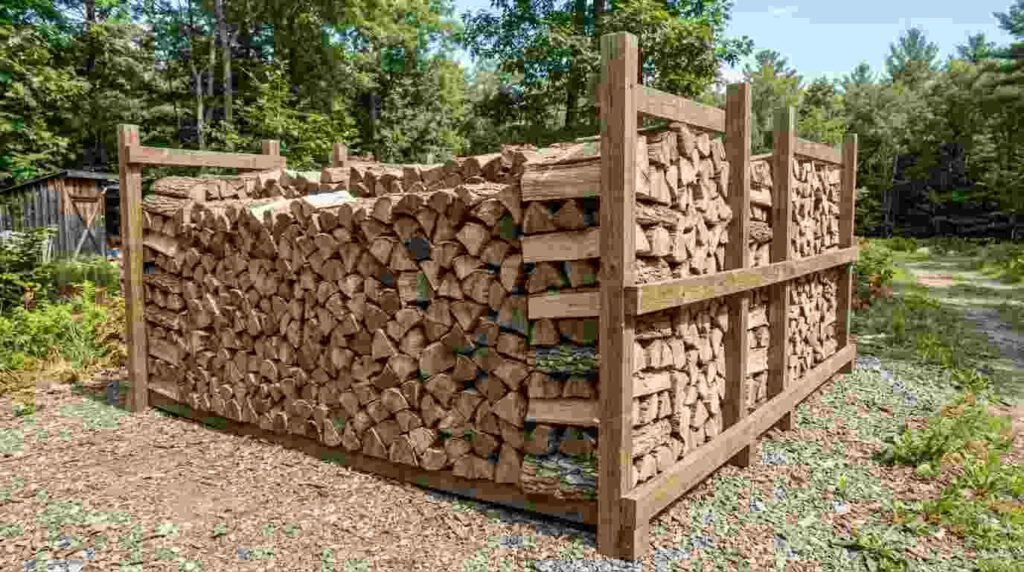
The only reliable way to verify a full cord is to stack the delivered wood and measure the dimensions.
A loose pile cannot be accurately measured against cord standards. Stack the wood neatly, then:
- Measure the total length — should be 8 feet for a full cord
- Measure the total height — should be 4 feet for a full cord
- Measure the depth — should match the piece length; at 16-inch pieces, three rows = 4 feet depth
- Multiply: Length × Height × Depth = should equal 128 cubic feet
If the result is noticeably below 128 cubic feet, contact your supplier immediately.
Understand How the Wood Is Stacked
Stacking method directly affects how much solid wood is actually present in a cord-sized stack.
Tightly stacked, uniform pieces — more solid wood per 128 cubic feet, less air space, better value.
Loosely arranged, irregular pieces — more air space per 128 cubic feet, less actual solid wood, reduced value even when dimensions are technically correct.
Quality firewood suppliers stack deliveries neatly and consistently. Loose, poorly arranged stacks that technically measure 128 cubic feet may still contain significantly less usable firewood than a tight, uniform stack of the same labeled dimensions.
Account for Log Length and Gaps
Log length is the variable most buyers overlook when checking a delivery. A supplier cutting pieces to 12 inches instead of the standard 16 inches will need to stack more rows to fill the same footprint — and if those additional rows are not present, the delivery is short.
Always ask your supplier:
- What is the cut length of each piece?
- How many rows wide is the stack at that piece length?
- Has the stack been measured before loading?
At 12 Point Farms LLC, every cord is accurately measured, stacked consistently, and delivered with full transparency on piece length and stack dimensions. For additional buyer verification guidance, read our properly stacking firewood guide
How to Stack and Store a Full Cord of Firewood
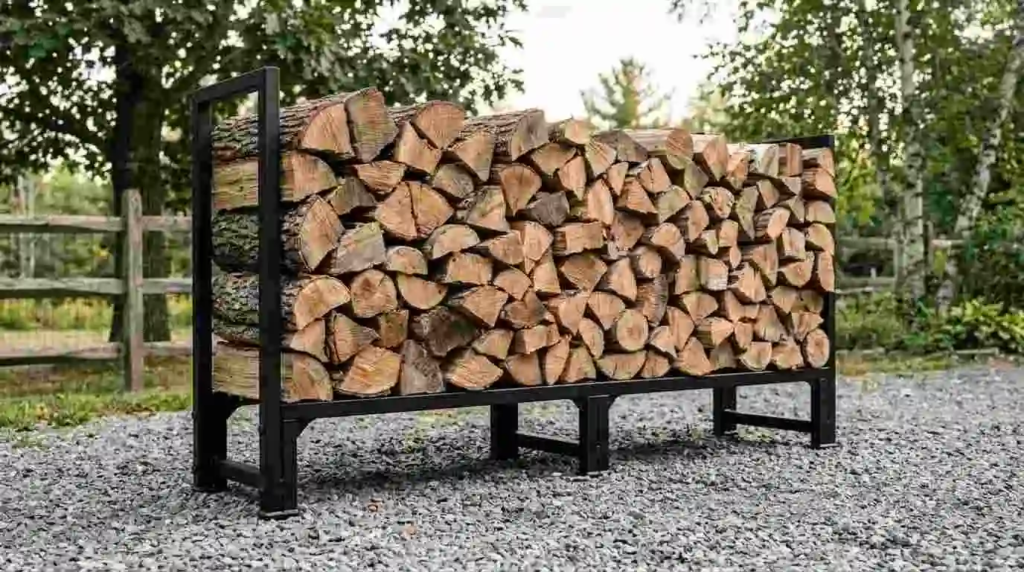
Receiving an accurately measured full cord is the first step. Storing it correctly ensures it stays dry, accessible, and ready to burn from the first piece to the last.
Keep Wood Off the Ground
Direct ground contact is the fastest way to damage a quality firewood delivery. Moisture from soil wicks into the bottom layers continuously — even in dry weather — and ground-dwelling insects use the direct contact as an access point into your wood supply.
Elevate your full cord on:
- A dedicated firewood rack
- Pressure-treated lumber rails
- Concrete blocks or pavers
- A wooden pallet
Minimum elevation: 4 to 6 inches above bare ground.
Allow Air Circulation
Airflow between pieces is essential for maintaining dryness throughout the storage period. A full cord that arrives properly dry can re-absorb atmospheric moisture if stored in conditions that trap humid air around the wood.
Best practices for airflow:
- Stack in a single row where possible — one piece deep with both faces exposed
- Keep at least 3 to 5 inches between the stack and any wall, fence, or structure
- Orient the stack in a location that receives direct sunlight for part of the day
- Avoid fully enclosed storage sheds unless they have adequate ventilation
Protect Firewood From Excess Moisture
Cover only the top of your full cord stack — never wrap the sides.
A tarp secured over the top surface protects against rain and snow while allowing air to circulate freely through the sides. Fully enclosing a stack in plastic traps atmospheric moisture, dramatically accelerates mold growth, and can re-wet kiln-dried or properly seasoned wood within weeks.
Additional moisture protection steps:
- ✔ Clear snow from the top cover after heavy accumulation to prevent melt-through
- ✔ Inspect the bottom layer periodically for dampness
- ✔ Rotate older wood to the front — use the most fully dried pieces first
- ✔ Bring only 24 to 48 hours worth of wood indoors at a time
For our complete seasonal storage protocol, visit firewood storage tips.
Common Mistakes When Measuring a Cord of Firewood
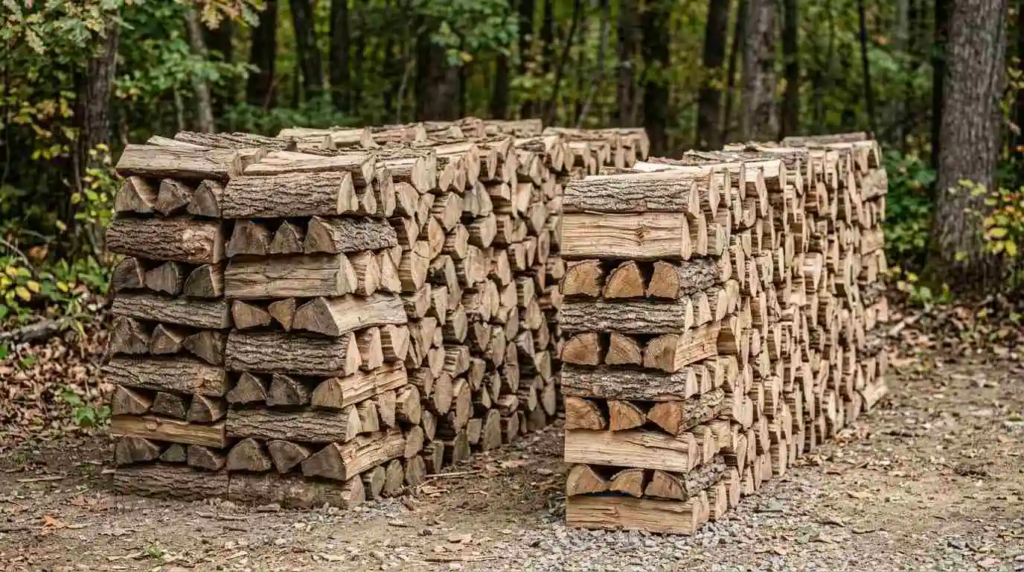
Confusing a Face Cord With a Full Cord
This is the most common and costly firewood measurement mistake buyers make. A face cord and a full cord look nearly identical when viewed from the front — both are 4 feet tall and 8 feet long. The depth is where they diverge completely.
A face cord at 16 inches deep contains approximately 43 cubic feet — one-third of a full cord. A buyer paying full cord prices for a face cord delivery loses approximately two-thirds of the wood volume they expected to receive.
Rule: Always ask whether you are being quoted for a full cord (128 cubic feet) or a face cord before placing any firewood order. Confirm piece length so you can calculate the expected depth.
Ignoring Log Length
Log length directly determines how many rows are needed to achieve a full cord depth. A supplier cutting pieces to 12 inches instead of 16 inches must stack an additional row to maintain the same 4-foot depth — and if they do not, the delivery is mathematically short.
Never assume a delivery is a full cord without confirming:
- The cut length of each piece
- The resulting number of rows needed at that length
- Whether the delivered stack includes all required rows
Estimating Quantity Without Measuring the Stack
Eyeballing a firewood delivery never accurately confirms a full cord. The only reliable verification method is measuring the stacked dimensions and calculating the volume.
Buyers who skip this step are vulnerable to receiving short-cord deliveries — sometimes significantly short — without any objective basis to dispute the quantity. Stack the wood, measure the stack, do the math. It takes five minutes and protects your full investment every time.
How to Determine if a Full Cord Is Right for Your Needs
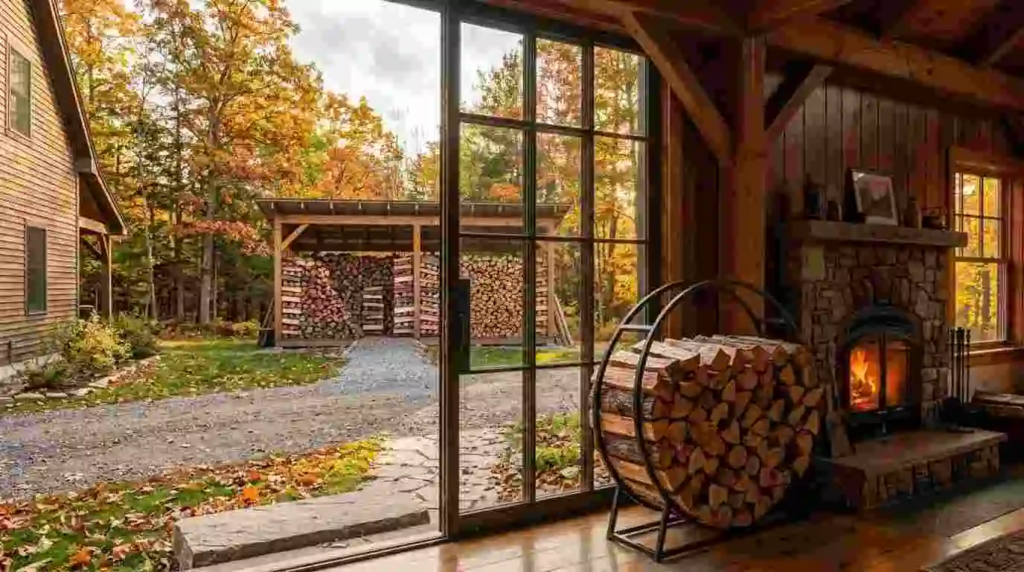
Estimate Your Seasonal Usage
Before ordering, estimate your actual seasonal consumption based on:
- How many fires you typically build per week during the heating season
- Whether your wood stove or fireplace is primary or supplemental heat
- The approximate length of your local heating season
Use the usage table from the earlier section as a starting framework, then adjust based on your specific situation. When in doubt, start with a half cord for your first purchase and track your actual burn rate across a month of normal use.
Consider Your Available Storage Space
A full cord of firewood requires a storage footprint of approximately 8 feet long by 4 feet wide. If your outdoor storage space is limited, a half cord (4 feet long × 4 feet wide × 4 feet deep) may be more practical — and you can order additional supplies mid-season as needed.
For guidance on storage space requirements and how to maximize limited space, see our half cord firewood guide.
Match Wood Quantity to Your Heating Method
Fireplace users who burn primarily for ambiance and occasional warmth typically do not need a full cord for a single season. A half cord or face cord is often sufficient.
Wood stove users who rely on their stove as a primary or significant supplemental heat source almost always need at least a full cord — and in colder climates like Wisconsin, multiple full cords for a complete heating season.
If you are comparing firewood quantities or sizing your order before purchasing, explore the full range of available firewood products and sizing options at 12 Point Farms LLC to find the quantity that fits your actual heating situation.
Frequently Asked Questions — Full Cord Firewood
What is a full cord of firewood?
A full cord of firewood is a standardized unit of measurement equal to 128 cubic feet of tightly stacked wood. It measures exactly 4 feet high × 4 feet wide × 8 feet long. It is the legally recognized standard firewood measurement in the United States.
How much wood is in a full cord?
A full cord contains 128 cubic feet of stacked volume. Approximately 80 to 90 cubic feet of that is solid wood. The remaining 38 to 48 cubic feet is natural air space between the stacked pieces — unavoidable given the irregular shape of split firewood.
What are the dimensions of a full cord of firewood?
A full cord measures 4 feet high × 4 feet wide × 8 feet long — totaling 128 cubic feet of stacked volume. These dimensions are fixed and consistent across the United States as the standard legal measurement for firewood sold by the cord.
Why is a full cord equal to 128 cubic feet?
128 cubic feet comes directly from multiplying the three standard cord dimensions: 4 ft × 4 ft × 8 ft = 128. This standard was established to create a consistent, measurable firewood quantity that buyers and sellers could use as a fair baseline for pricing and delivery.
How do you measure a full cord of firewood?
Stack the delivered wood neatly, then measure the length, height, and depth of the stack. Multiply all three dimensions together. The result should equal approximately 128 cubic feet for a full cord: 8 ft × 4 ft × 4 ft = 128. Always stack before measuring — a loose pile cannot be accurately compared against cord standards.
What is the difference between a full cord and a face cord?
A full cord = 128 cubic feet (4×4×8 ft). A face cord = approximately 43 cubic feet (4 ft × 8 ft × 16 inches deep). A face cord is one-third of a full cord. Both appear identical when viewed from the front. The depth measurement is the critical difference. Never pay full cord pricing for a face cord delivery.
What is the difference between a full cord and a rick?
A rick is the same as a face cord in most US regions — approximately 43 cubic feet of stacked wood, measuring 4 feet high × 8 feet long × 16 inches deep. A rick is roughly one-third of a full cord. The term “rick” is more common in the Midwest; “face cord” is more standard in the Northeast.
How long does a full cord of firewood last?
It depends on use frequency, appliance efficiency, wood species, and climate. As a general guide: occasional recreational fireplace users may get a full season or more from half a cord. Supplemental heating users typically burn 1 to 2 cords per season. Primary wood stove users heating through a Wisconsin winter may need 3 to 5 full cords.
How much does a full cord of firewood weigh?
A full cord of firewood weighs between 2,000 and 5,000 pounds depending on species and moisture content. Dense, green hardwood like oak at the high moisture end can approach 5,000 pounds per cord. Properly seasoned or kiln-dried hardwood of the same species typically weighs 2,500 to 3,500 pounds per cord.
How much space does a full cord of firewood require?
A full cord requires a storage footprint of approximately 8 feet long × 4 feet wide, stacked to 4 feet high. Plan for slightly more space around the stack to allow airflow on the sides and a cover over the top. If space is limited, a half cord (4 ft × 4 ft × 4 ft) may be a more practical initial purchase.
How should a full cord of firewood be stacked?
Stack firewood elevated off bare ground on a rack or pallet. Arrange pieces in a single row with both faces exposed to air. Cover only the top with a tarp — never seal the sides. Keep the stack at least 3 to 5 inches away from walls or fences for airflow. Choose a sunny, well-ventilated location for the best long-term storage results.
How do you know if a stack contains a full cord?
Stack the wood neatly and measure: 8 feet long × 4 feet high × 4 feet deep = 128 cubic feet. If the result is significantly below 128 cubic feet, the delivery is short. Also confirm the cut length of each piece — piece length determines how many rows are needed to achieve the 4-foot depth at a full cord.